eDNAplus - paper published in JASA
Published:
eDNAPlus: A Unifying Modeling Framework for DNA-based Biodiversity Monitoring
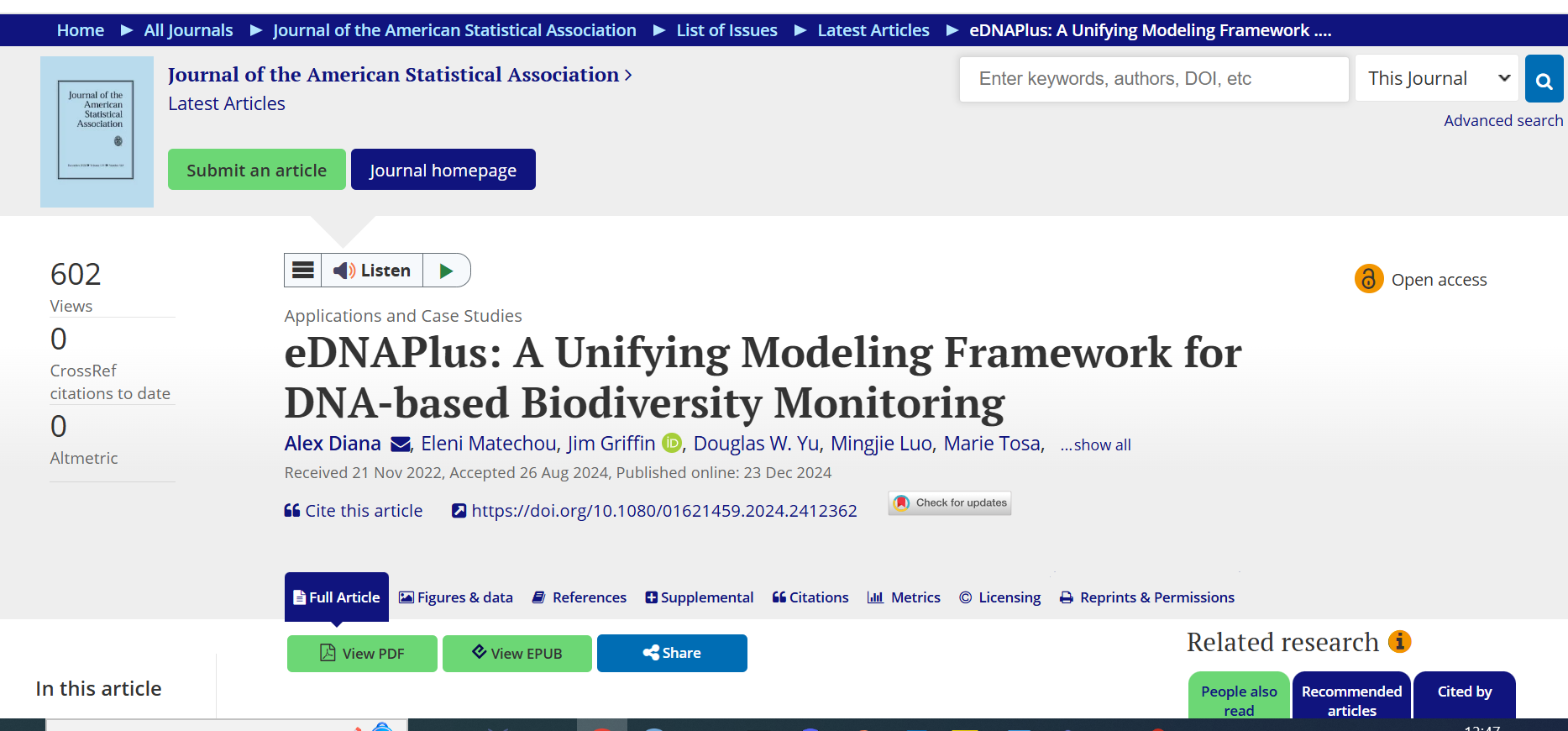
by Alex Diana, Eleni Matechou, Jim Griffin, Doug Yu, Richard Griffiths, and others.
Abstract:
DNA-based biodiversity surveys, which involve collecting physical samples from survey sites and assaying them in the laboratory to detect species via their diagnostic DNA sequences, are increasingly being adopted for biodiversity monitoring and decision-making.
The most commonly employed method, metabarcoding, combines PCR with high-throughput DNA sequencing to amplify and read “DNA barcode” sequences, generating count data indicating the number of times each DNA barcode was read. However, DNA-based data are noisy and error-prone, with several sources of variation, and cannot alone estimate the species-specific amount of DNA present at a surveyed site (DNA biomass).
In this article, we present a unifying modeling framework for DNA-based survey data that allows estimation of changes in DNA biomass within species, across sites and their links to environmental covariates, while simultaneously accounting for key sources of variation, error, and noise in the data-generating process, as well as between-species and between-sites correlation.
Bayesian inference is performed using MCMC with Laplace approximations. We describe a re-parameterization scheme for crossed-effects models designed to improve mixing, and an adaptive approach for updating latent variables, which reduces computation time.
Theoretical and simulation results are used to guide study design, including the level of replication at different survey stages and the use of quality control methods. Finally, we demonstrate our new framework on a dataset of Malaise-trap samples, quantifying the effects of elevation and distance-to-road on each species, and producing maps identifying areas of high biodiversity and species DNA biomass.
Supplementary materials for this article are available online, including a standardized description of the materials available for reproducing the work.